
Here’s what we learned from thoughtfully incorporating AI into our product development process. From the very first research question to shipping clinically validated solutions, we’re sharing the details of how we’ve put AI to work.
Every company is talking about leveraging AI. The more important questions are what it’s changing and whether it’s actually leading to better products.
At Arcweb, instead of bolting AI onto client projects or running it as a side experiment, we use it to research, plan, design, build, and validate. Over the past year, we’ve rebuilt our workflow around it, one discipline at a time.
Here’s what that looks like day to day: the tools we use, where they help, where they don’t, and the lesson that keeps coming up:
Speed only matters if you can trust what you shipped.
Quality is the standard we work to. As an AI product studio, Arcweb launches impactful, clinical-grade solutions for digital health leaders, innovators, and founders. AI helps us move at lightning speed and our process ensures every solution meets the rigorous standards healthcare demands.
Research and strategy: Sharper start with AI
The first few weeks of an engagement are critical to a project’s success; we’ve found success in employing AI during these crucial early stages.
Today’ s AI models make for great research tools. Models like Claude’s Opus and Chat GPT’s Astra help accomplish several important functions:
- Get up to speed on a new clinical or regulatory area
- Pull themes out of interview notes
- Poke holes in our assumptions
- Draft competitive landscapes that our strategists can then check and challenge
Rather than skipping the thinking, we’re getting to the right conclusions sooner.
Healthcare and AI projects often involve highly specialized domains, whether it’s a care-delivery workflow, a legal process, or a rehabilitation protocol. AI helps our team get up to speed on the nuances of each domain faster, allowing us to ask the right questions in days instead of weeks.
One principle guides our approach: AI may accelerate the work, but human expertise drives decisions. Every insight that shapes a roadmap is traced back to a real source, a real user, or a real stakeholder conversation.
How AI tools speed up prototyping and UX design
Design is where our AI adoption has moved fastest. In a short span, we leverage three tools, and each one changes what a “design deliverable” means.
Figma Make came first, allowing us to turn prompts and existing designs into interactive prototypes within a familiar design environment. It dramatically accelerated our prototyping process, enabling us to create high-fidelity, responsive designs in record time without manually building every breakpoint.
Claude Design has become a daily essential. We use it to explore concepts, generate and refine UI, and build presentation-ready work. Claude Design and Figma complement each other well, giving our team the flexibility to explore creative concepts in Claude while leveraging Figma’s established design and prototyping capabilities. Claude Design has also transformed the way we create decks by giving them a coat of polish that’s impossible in a tool like Google Slides. We can refine in minutes and try more creative ideas than ever before.
Lovable takes our prototyping capabilities a step further, allowing us to build functional applications with working logic and real data. It’s a game-changer for our design team, enabling us to put working products in front of clients and users much earlier in the development process.
Being able to implement a simple auth flow that leverages Google SSO or a database and backend; something that would require a developer’s time, is a huge win and blurs the line between designer and developer, getting our team ever closer to the mythical unicorn status.
Across all three, the big change is that we test real behavior sooner. Clients see their idea working before they commit a major build budget. Rather than static screens stitched together, clients can react to something that feels alive. That way, our designers spend less time pushing pixels and more time on flows, edge-cases, usability, accessibility, data, and trust.
How our engineers use Claude for coding, testing, and code review
Our engineers use AI across the whole build: scaffolding, refactoring, writing tests, reviewing pull requests, and documenting as they go. For many, AI has become central to their day-to-day workflow.. As one of our architects put it:
“Working with Claude is like pair programming with an inhumanly smart junior developer.”
Howard Swope – Arcweb Software Architect
We noticed that Claude started paying off once we gave it a project-specific setup. The key, according to Howard, is simple: “Managing context is the key to making Claude effective.”
In practice, effective implementation comes down to two habits:
- Focused context – We’ve organized a project’s code into a monorepo containing several sub-projects, then structured Claude’s instructions to match. When working from the root, Claude receives general project context. Within a sub-project, it follows instructions specific to that part of the code. Additional rules guide how the system should evolve over time, helping Claude consider the long-term impact of each change.
- Paired perspectives – One Claude session writes a piece of code and its unit tests. A second session, with no stake in the original code, reviews and extends those tests. The first knows exactly how the code works. The second has no bias toward the happy path. Together, they catch more than either would alone.
The speed gain is real, but the bigger shift is where senior staff attention is spent focusing. With AI handling more routine coding tasks, they can devote greater attention to architecture, security, interoperability, and critical clinical logic. The result is a more refined, robust product built on a solid technical foundation.
In healthcare, that trade-off is the whole point. Generated code still goes through human review, automated testing, and the same quality gates as everything else we ship. AI raises our ceiling; it never lowers our floor.
The challenges of building custom AI models, and how we validate them
Using AI tools is the easy part. Building AI into a product that people rely on is where most teams stall. We’ve been through it.
Developing custom AI models has taught us valuable lessons that only come from real-world implementation. Off-the-shelf models rarely meet the demands of specialized domains without careful data preparation, governance, and ongoing monitoring for output drift. Above all, we’ve learned that a model performing well in a demo doesn’t necessarily mean it’s safe or reliable enough for real-world use.
That last gap is why we built our own clinical validation toolset. The tool lets us test AI-driven recommendations against clinical expectations before they reach users and continue testing them as the product changes. It works by evaluating prompt versions side-by-side using explicit rubrics and AI judges, making improvements measurable and catching regressions before release.
This is a big deal and we’re not done talking about this critical infrastructure that many projects lack and products fail without. Stay tuned for future blog posts directly from our AI experts, and reach out if you want to see how this can improve your organization’s AI initiatives.
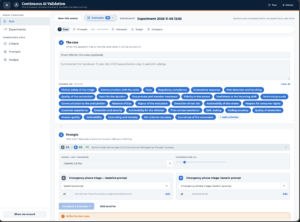
We initially developed our clinical validation toolset for a single project, intentionally designing it to be reusable across future engagements. Now, new digital health clients benefit from an established validation framework from day one, allowing us to accelerate development while maintaining the rigorous standards clinical-grade solutions demand.
That’s what we mean by clinical-grade: a repeatable way to prove an AI product does what it claims, correctly and most importantly, safely.
Field notes: core capabilities and AI applications in practice
Here are three key areas where our technical capabilities showcase the practical range of modern AI implementations.
AI-native workflow management
We engineered an AI-native workflow and case management environment where intelligence is deeply embedded into every layer of the user experience. By focusing on data integrity, clear audit trails, and automated decision-support, the solution streamlines complex operational processes while ensuring system reliability and human oversight remain intact.
Content analysis and human-in-the-loop validation
We leverage AI heavily to think outside of the box and visualize content structure in a unique way across advanced content analysis platforms. By combining heuristic analysis with modern machine learning models, our technology evaluates and elevates multi-modal inputs—driving innovative solutions, rewarding genuine originality, and unlocking new frontiers in automated content workflows.
High-stakes algorithmic guidance and automated clinical evaluation
We designed an intelligent recommendation engine for guided care and recovery protocols. Because accurate guidance is critical in health settings, this system powered the deployment of our automated validation suite, allowing real-time verification of model recommendations against strict domain benchmarks.
Across each technical domain, the core strategy remains consistent: leverage AI automation where it drives velocity, and implement rigorous verification wherever accuracy matters.
What this means if you’re building with us
We stay on the frontier so our clients don’t have to. We try the new tools, work through the learning curve, and keep only what improves outcomes. You get the benefit without the trial and error.
In practice, that means:
- Faster validation: Working prototypes in front of users & stakeholders early, before the big build spend.
- Senior focus where it counts: AI handles the routine so experts can focus on architecture, safety, and the user experience.
- Proven infrastructure: Reusable validation tooling and hard-won lessons from custom model work, ready on day one.
- Values-driven work: As a certified B Corp, we weigh impact on people alongside speed and cost.
The tools will keep changing but the goal won’t: getting the right product to the people who need it, on time, on budget, and built to a standard they can trust.
Have an AI or health-tech idea you need to get off the ground? Let’s talk about it.